FAF™ | Unified Domains
One Standard. Five Domains.
A Single Defensible Readiness Score.
Framework Foundations
FAF™ is structured around five integrated domains that together define data platform assurance.
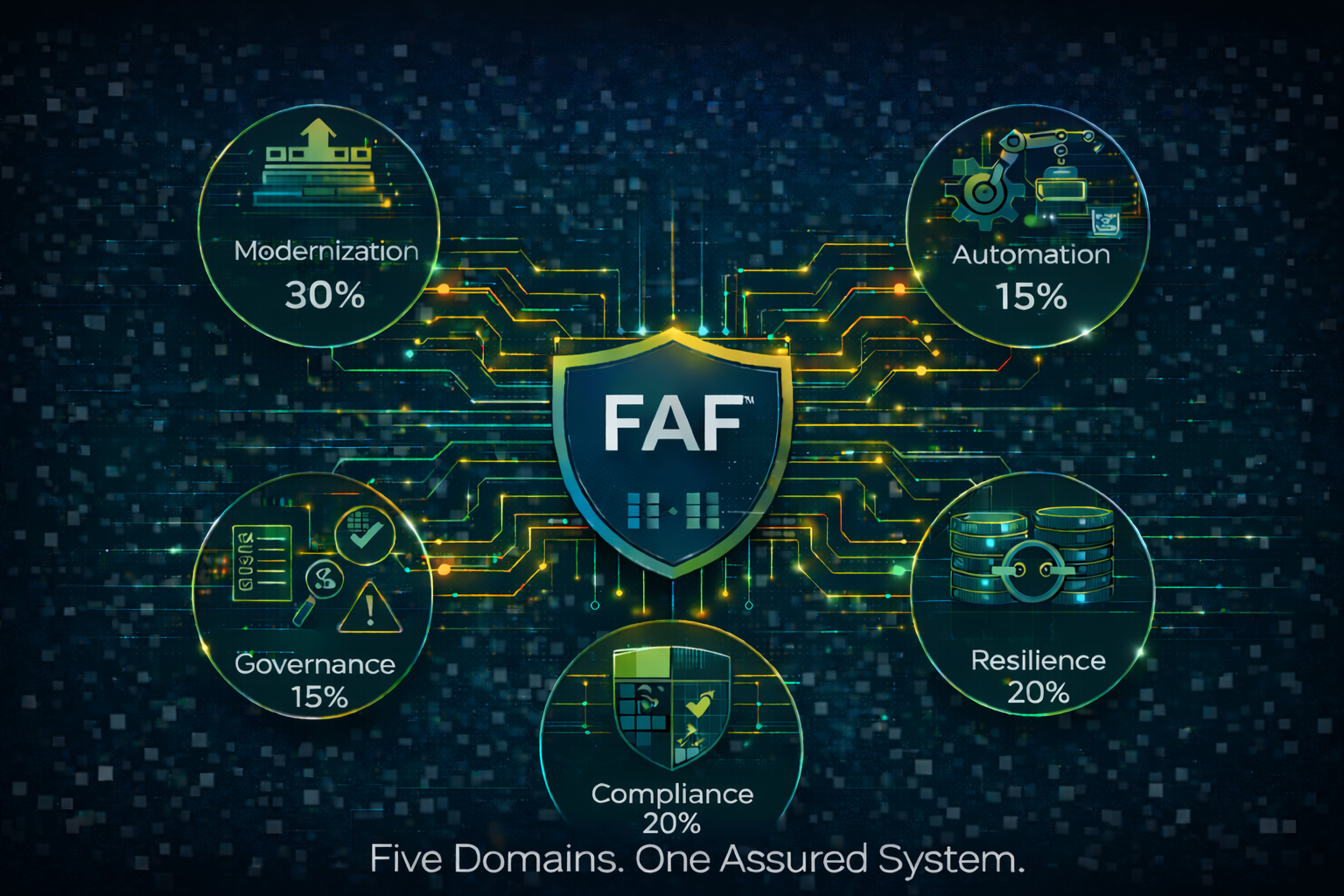
Each domain measures a distinct but interdependent dimension of risk. No domain is assessed in isolation — because real-world failures emerge where architecture, controls, operations, and accountability intersect.
FAF™
Weighted Domains
The risk-weighting logic behind the Unified Readiness Score
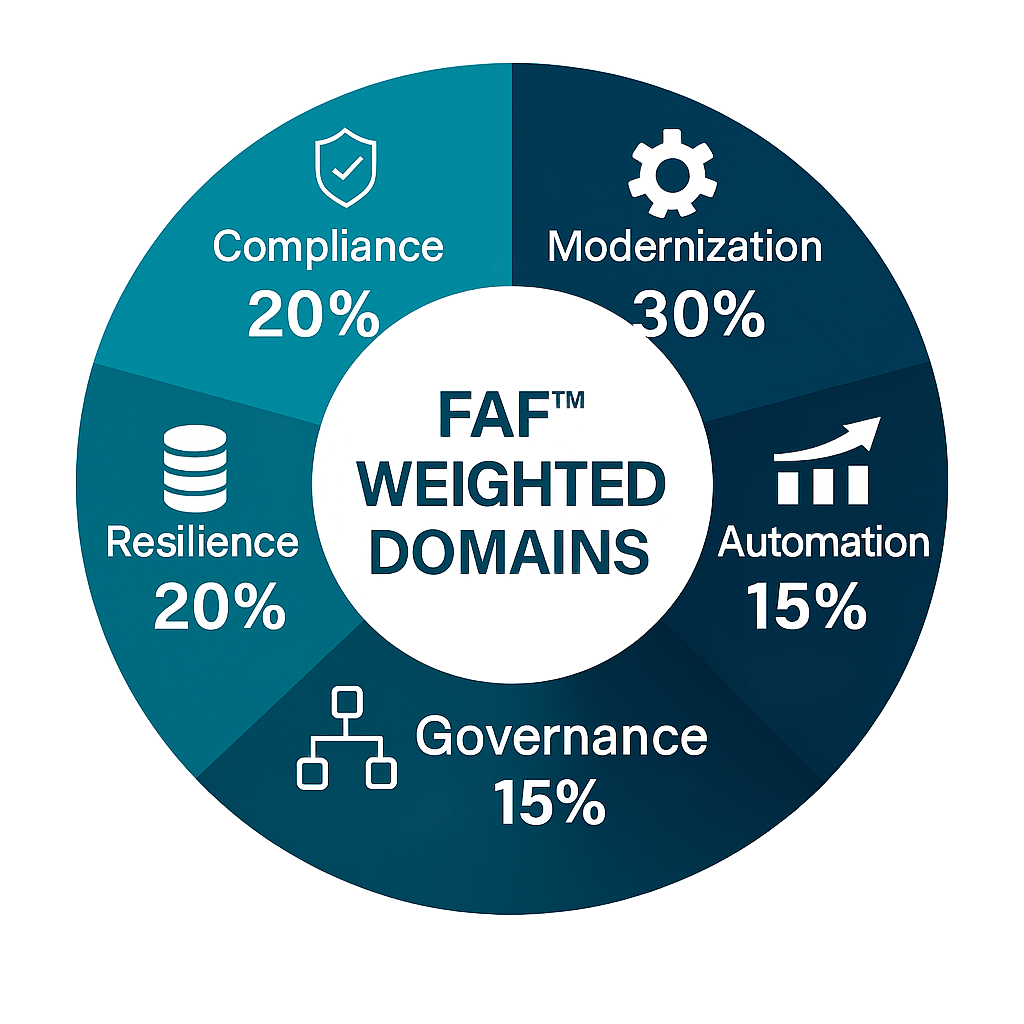
Weights reflect systemic risk contribution, not implementation effort or delivery complexity.
The FAF™ Weighted Domains Wheel visualizes relative risk weighting across modernization, compliance, resilience, automation, and governance—providing leaders with a defensible benchmark to prioritize assurance efforts and address systemic risk where it matters most.
From weighted priorities to domain-level assurance, the sections below show how FAF™ translates risk weighting into measurable, enforceable controls.
Domain Detail — Risk-Weighted Contribution
Modernization
30%
Architectural Readiness as a Measurable Control
Domain Definition
Modernization measures the architectural currency and structural readiness of the data platform. It evaluates cloud adoption readiness, standardization maturity, and exposure to technical debt that constrains predictable change.
Representative Modernization Signals
- Cloud readiness: ≥ 80% of workloads assessed as cloud-ready with documented dependency mappings
- Technical debt ratio: ≤ 15% across core platforms and shared services
- Standardization coverage: ≥ 90% adoption of Infrastructure-as-Code, golden images, and approved reference architectures
- Upgrade cadence: Critical components patched within 30 days of release
Why Weighted at 30%
Modernization carries the highest weight because it is the primary determinant of transformation leverage. It governs delivery velocity, enables resilience and automation, and constrains long-term cost efficiency. Where modernization is weak, gains in automation, resilience, and compliance cannot be sustained.
Without modernization, transformation stalls and costs escalate. A future-ready architecture restores agility, scalability, and control for sustainable growth.
Modernization is the foundation of assurance. Without it, resilience and compliance cannot be sustained.
Operational Resilience
20%
Architectural Readiness as a Measurable Control
Domain Definition
Resilience measures the data platform’s ability to withstand disruptions and recover predictably under adverse conditions. It evaluates failover readiness, incident response maturity, and systemic safeguards that prevent cascading failures.
Representative Resilience Signals
- Failover readiness: 95% of critical workloads tested for automated failover
- Incident response SLAs: Recovery time objectives (RTO) under 30 minutes for Tier-1 systems
- Redundancy coverage: 90% adoption of multi-zone or multi-region deployments
- Backup & restore assurance: ≥ 95% of Tier-1 systems with tested restore procedures meeting RPO targets
Why Weighted at 20%
Resilience is the backbone of assurance. It mitigates operational risk and sustains continuity when modernization or automation falters. Without resilience, compliance and governance cannot hold under systemic shocks.
Without resilience, operational continuity collapses under stress. Robust failover and rapid recovery safeguard operations and sustain assurance.
Resilience is the assurance backbone—without it, modernization and compliance collapse under stress.
Regulatory Compliance
20%
Architectural Readiness as a Measurable Control
Domain Definition
Compliance measures the platform’s ability to meet regulatory, contractual, and industry obligations. It evaluates control design and operating effectiveness across privacy, data protection, retention, access governance, and audit readiness—ensuring evidence-backed conformance that withstands scrutiny
Representative Compliance Signals
- Policy-to-control mapping: ≥95% of in-scope requirements mapped to implemented controls
- Access governance: 100% of Tier‑1 systems under least-privilege with quarterly recertification
- Data protection: ≥90% encryption coverage for sensitive datasets at rest and in transit
- Retention & deletion: Automated retention and defensible deletion for ≥85% of regulated records
Why Weighted at 20%
Compliance sustains institutional trust and regulatory defensibility. It reduces exposure to fines, sanctions, and operational disruption, anchoring governance so modernization and resilience operate within enforceable boundaries. Without robust compliance, assurance collapses under regulatory pressure—even when technically strong.
Without compliance, regulatory risk escalates and assurance fails under scrutiny. Audit-ready controls and defensible governance safeguard trust.
Compliance is the assurance gatekeeper—without it, governance loses enforceability and both modernization and resilience cannot withstand audits.
Data Governance
15%
Architectural Readiness as a Measurable Control
Domain Definition
Governance measures the strength of policies, standards, and oversight mechanisms that ensure data integrity, accountability, and ethical use. It evaluates stewardship maturity, metadata management, lineage tracking, and enforceability of governance frameworks across the platform.
Representative Governance Signals
- Policy enforcement: ≥90% of governance policies automated through platform controls
- Data lineage: Complete lineage tracking for ≥85% of critical datasets
- Metadata quality: ≥95% of business-critical assets with standardized, validated metadata
- Stewardship maturity: Assigned data owners for 100% of Tier‑1 domains
Why Weighted at 15%
Governance anchors assurance by enforcing accountability and ethical data practices. It prevents uncontrolled data sprawl, strengthens compliance, and ensures modernization efforts align with organizational standards. Without governance, resilience and compliance lose enforceability, and systemic risk escalates.
Without governance, data integrity erodes and accountability fails. Strong stewardship and enforceable standards sustain trust and control.
Governance is the assurance anchor—without it, compliance weakens and modernization loses enforceability.
Data Automation
15%
Architectural Readiness as a Measurable Control
Domain Definition
Automation measures the platform’s ability to reduce manual intervention through orchestrated workflows, self-healing mechanisms, and intelligent observability. It evaluates deployment automation, incident response automation, monitoring coverage, and predictive analytics that sustain operational efficiency and assurance.
Representative Automation Signals
- Deployment automation: ≥90% of Tier‑1 workloads deployed via Infrastructure-as-Code
- Incident response automation: Automated remediation for ≥80% of recurring incidents
- Monitoring coverage: 100% of critical systems under unified observability dashboards
- Runbook automation: ≥90% of operational tasks codified into executable scripts
Why Weighted at 15%
Automation accelerates modernization and resilience by reducing human error and improving response speed. It enables proactive assurance through predictive insights and self-healing capabilities. Without automation, operational overhead rises, and assurance becomes reactive rather than continuous.
Without automation, inefficiencies multiply and risk visibility fades.
Intelligent workflows and observability drive speed, stability, and control.
Automation is the assurance accelerator—without it, resilience slows and modernization loses momentum.
FAF™ Unified Assurance Summary
FAF™ consolidates modernization, resilience, compliance, governance, and automation into a single evidence-driven assurance standard. Each domain is independently assessed, risk-weighted, and reconciled into a defensible readiness score—providing leadership with an auditable view of systemic risk and clear priorities for strengthening assurance.